
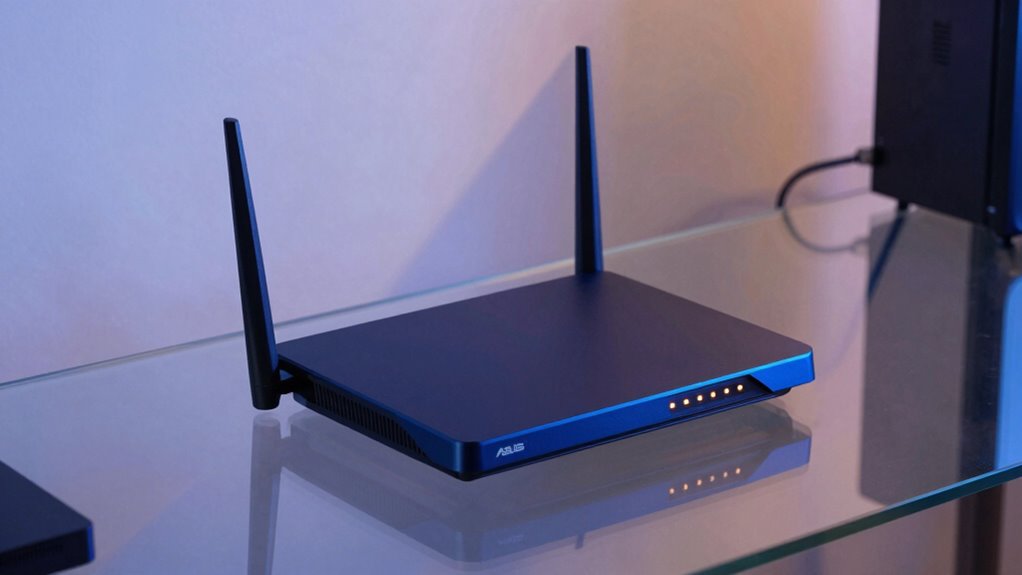
The ASUS AC1750 RT-AC66U B1 is a dated wall-mount router with a compact chassis and three external antennas. Its 1 GHz CPU and 3×3 radios deliver real-world throughput that generally meets 1750 Mbps only under optimal conditions; walls and interference reduce gains. AiProtection and adaptive QoS add value, but firmware is opaque and updates essential. Setup is web-first with a basic mobile app, though advanced options demand desktop access. For adopters, price and bundles matter—more improvements await elsewhere, yet curiosity remains.
Design and Hardware Overview
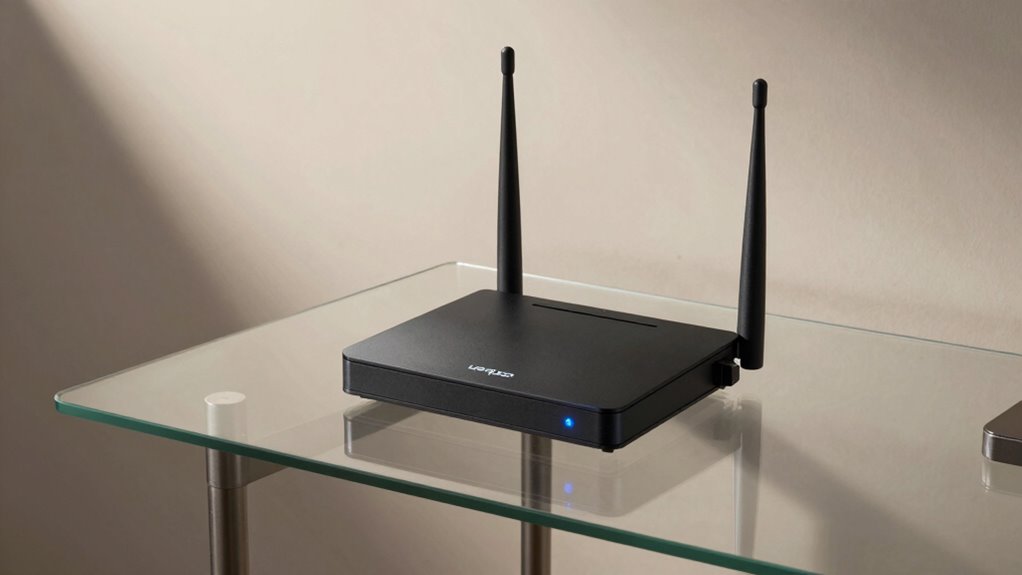
The design of the RT-AC66U B1 centers on a compact, wall-mountable chassis housing three external antennas and a trio of USB ports, emphasizing a straightforward, utilitarian form factor.
The enclosure favors minimal ornamentation over ergonomic cues, with placement aimed at practical mounting rather than aesthetic appeal.
Internally, the 1GHz CPU and 3×3 radios support standard dual-band operation, though chassis bulk suggests room for component optimization.
Observers should separate functional capability from marketing fluff, noting potential design flaws such as thermal management and port layout constraints.
Performance and Coverage Assessment
How well does the RT-AC66U B1 deliver on speed and reach in real-world use? In testing, throughput aligns with its 1750 Mbps label only under optimal conditions; real walls and interference reduce performance predictably, exposing the limits of its 3×3 antennas at distance. Coverage claims around 3,000 square feet are achievable, but signal degradation and channel contention temper expectations for dense layouts. The design critique notes practical gains from ASUSWRT features and AiMesh, yet the hardware shows dated efficiency compared with modern rivals. Price analysis suggests modest value, contingent on given features over simpler routers. Overall performance remains serviceable but not remarkable.
Features and Security Suite

ASUS equips the RT-AC66U B1 with a layered security and management package that extends beyond basic routing functions. The package includes AiProtection powered by Trend Micro and SPI/DoS firewall protections, reinforcing perimeter defense. Parental controls and Adaptive QoS address usage policies, yet their impact remains modest for advanced users. Security features are practical but not groundbreaking, and routine firmware updates are essential to maintain protection. Firmware updates are documented, though the process can be opaque within the web interface.
Setup Experience and Ease of Use
One quickly notes that the setup experience with the RT-AC66U B1 centers on a straightforward, web-first configuration augmented by a mobile app, but execution benefits from clear guidance and cautious expectations about interface clarity.
The process favors a sequential, web-driven wizard that exposes essential options with minimal friction, yet some terminology remains ambiguous.
The mobile app usability offers parity for basic tasks but lacks depth for advanced settings, requiring occasional desktop access.
Overall, setup duration remains reasonable, though users should anticipate cross-platform steps and verify WAN/LAN assumptions before enabling AiMesh features.
Technical clarity dominates, not polish.
Pros, Cons, and Final Verdict
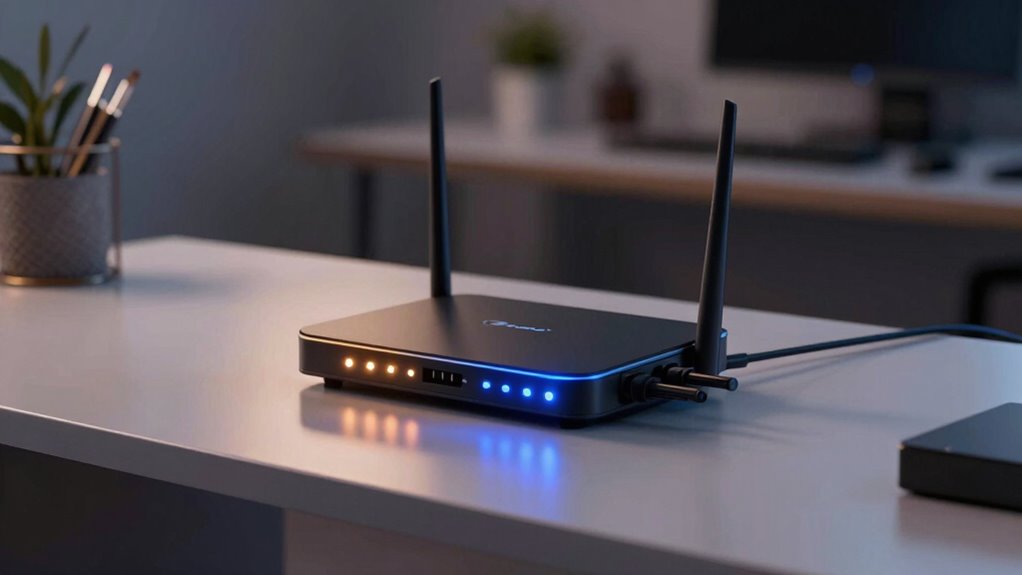
The RT-AC66U B1 presents solid performance for a 2016-specified dual-band router, delivering reliable 2.4 GHz and 5 GHz coverage with easy AI Mesh compatibility and enterprise-grade features like AiProtection and adaptive QoS; however, the hardware age and user-interface clarity limit its appeal against newer models offering more streamlined setups and longer software support.
Pros include strong security features and broad compatibility, while Cons center on dated firmware, slower processing, and opaque menu navigation.
Prospective price remains competitive only in bundles or used markets, and competitor comparisons consistently favor newer routers with modern interfaces and extended updates.
Final verdict: cautious adopters only.
Conclusion
The RT-AC66U B1 remains a serviceable, feature-rich router for traditional homes, yet its age shows in performance ceilings and firmware cadence. While AiProtection and AiMesh offer some long-term value, the hardware lags behind modern Wi‑Fi 6 options in throughput and efficiency. For budget-conscious buyers prioritizing stability and robust management, it still delivers; for future-proofing or high-demand wireless tasks, newer models are more prudent. In sum, solid now, limited for tomorrow.