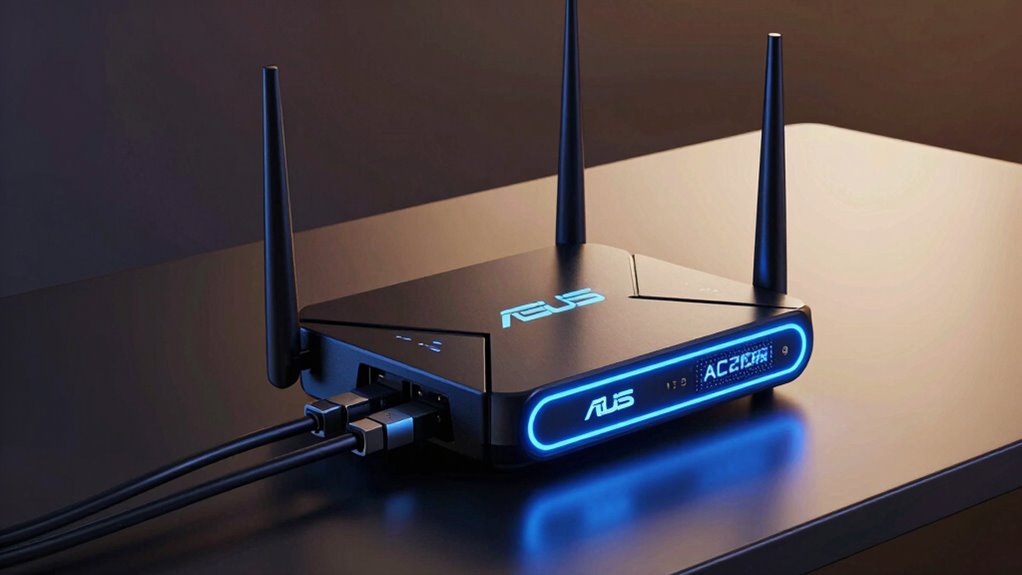
The ASUS AC2600 Blue Cave blends a distinctive cylindrical chassis with solid wireless coverage and robust security features. Its design prioritizes heat management and a premium feel, though the gleaming surface is fingerprint-prone. Performance shows strong 5 GHz short-range gains but bottlenecks under sustained load, with AiMesh offering flexibility yet variable results as node count grows. Security benefits include AiProtection powered by Trend Micro and comprehensive parental controls, though aging firmware and ambiguous MU-MIMO claims temper value. More details await.
Design and Unboxing
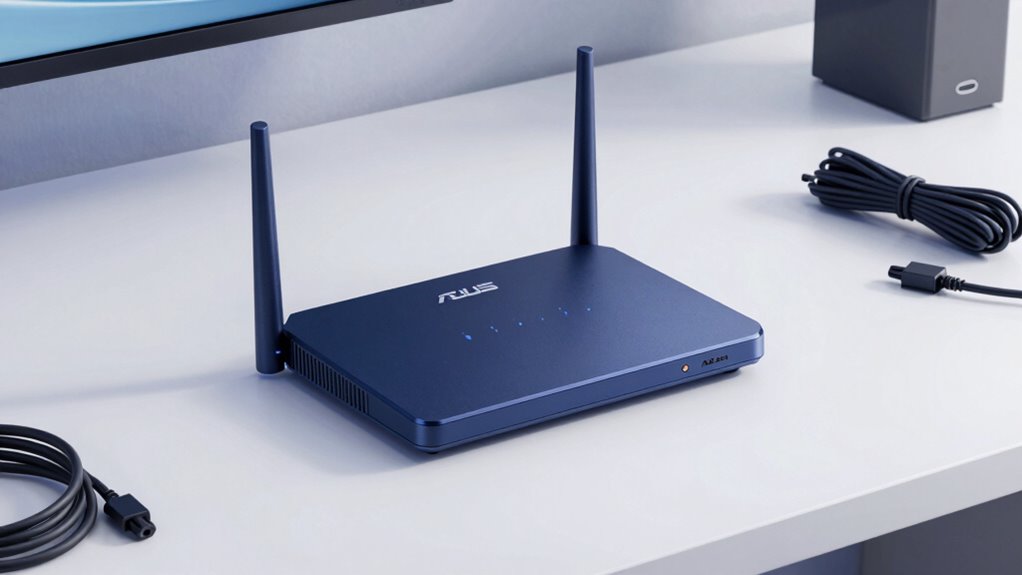
The ASUS AC2600 Blue Cave presents a distinctive, cylindrical chassis that departs from traditional router silhouettes. The design is a deliberate bold statement rather than a neutral enclosure, inviting a design critique of form versus function.
Its vertical symmetry concentrates heat dissipation pathways while minimizing footprint, yet the rounded exterior edges invite handling considerations during unboxing impressions.
The unboxing reveals sturdy materials and careful labeling, with internal packing balancing protection and accessibility.
Materials feel premium, though the gleaming surface invites fingerprint marks.
Performance and Throughput
Moving from design considerations to real-world operation, the ASUS AC2600 Blue Cave’s performance and throughput are examined through measured wireless benchmarks and practical network behavior. The assessment notes a clear design focus on solid coverage and stable links, yet throughput reveals bottlenecks under sustained load. 2.4 GHz remains adequate for basic tasks, while 5 GHz shows peak gains only with short-range sessions. AiMesh helps consistency but introduces variability with multiple nodes.
Features and Security Suite

The ASUS AC2600 Blue Cave packs a thorough security and feature suite that positions it as a midrange router with enterprise-minded protections. It presents AiProtection powered by Trend Micro, delivering external threat blocking and 24/7 assurances, complemented by mobile and PC antivirus coverage. The security integration is notable, offering 1-year Trend Micro mobile protection and parental controls that map usage, devices, and schedules across platforms. From a design critique perspective, the suite emphasizes centralized control via the Asus Router app, yet may overwhelm casual users with granular options. Overall, features align with demand for robust defense without sacrificing network flexibility.
Setup Experience and AiMesh Compatibility
Setting up the ASUS AC2600 Blue Cave is straightforward via the Asus Router app, which guides users through a sequential, app-driven configuration that emphasizes quick network boot and basic security enablement. The process is efficient but reveals setup flaws when AiMesh is introduced: initial node discovery can lag, and manual IP adjustments occasionally resist automatic seamless handoff. AiMesh compatibility is solid on recent firmware, yet mesh stability varies with device count and channel congestion. Unboxing surprises include compact power needs and minimal cables, underscoring a hardware approach focused on simplicity over extendable topology. Overall, setup is competent but not flawless.
Pros, Cons, and Final Thoughts
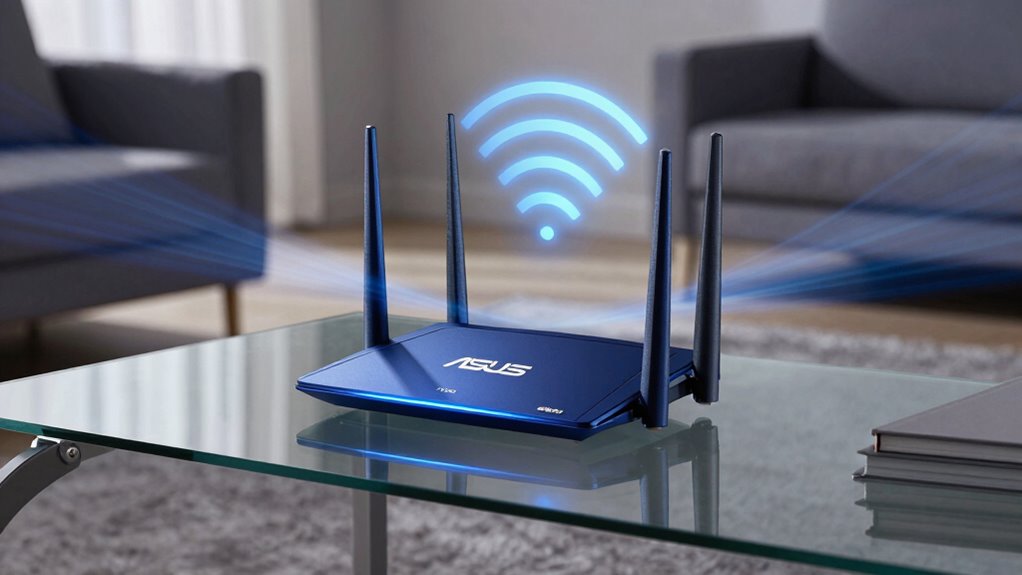
Overall, the ASUS AC2600 Blue Cave presents a compelling blend of performance-oriented hardware and robust security features, delivering solid throughput and broad device support while highlighting some trade-offs inherent to its design.
The pros center on AiProtection, Trend Micro protections, AiMesh flexibility, and strong parental controls, which bolster ongoing network safety and management.
Drawbacks include its discontinued status, potential firmware gaps due to age, and the ambiguous 4×4/2×2 claims relative to real-world MU-MIMO scenarios.
Prospects for future adoption hinge on continued security updates and seamless integration with AiMesh; drawbacks involve limited availability and uncertain long-term support.
Conclusion
The ASUS AC2600 Blue Cave remains a compelling historical benchmark for mid-range routers, notable for its distinctive form, ambitious security suite, and AiMesh potential. Yet, its aging hardware and evolving Wi‑Fi standards constrain practical value in modern homes, where newer devices deliver stronger throughput and streamlined support. For enthusiasts and researchers, the Blue Cave offers critical lessons in design balance and software ambition; for typical buyers, it’s a niche curiosity whose relevance wanes as ecosystems advance.