The ASUS ROG Swift 27” 1440p OLED blends a premium, rigid chassis with a compact silhouette and glare-minimizing finish. It delivers near-perfect blacks, 99% DCI-P3, and a true 10-bit pipeline, with Delta E < 2 for accurate gradients. Performance centers on 240 Hz with 0.03 ms GtG and G-SYNC compatibility, plus HDR in 3% highlights. Connectivity is dense via DP 1.4 and HDMI options, though EDID quirks can appear. Further details await those who continue.
Design and Build Quality
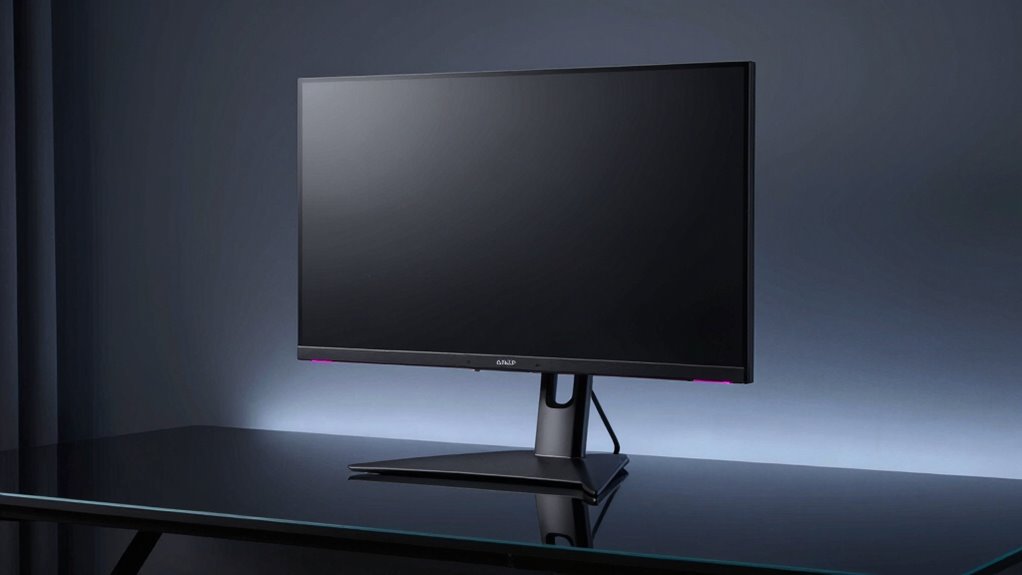
The ASUS ROG Swift PG27AQDM presents a purpose-built chassis that emphasizes a compact, premium silhouette with a black finish and angular lines. Data indicates a rigid frame constructed from metal and reinforced plastics, contributing to a solid weight distribution and minimal flex under typical desk loads. Build materials appear chosen to balance heat dissipation with aesthetic cohesion, while seam tolerances reflect careful assembly. Despite overall precision, minor design flaws emerge in edge detailing and cable management channels, affecting perceived cleanliness. Finishes resist glare but show micro-scratches with prolonged handling. In aggregate, the build projects durability while limiting overt bulk.
Display Performance and Image Quality
Measured against its OLED baseline, the PG27AQDM delivers near-perfect blacks, high contrast, and rapid response times, fundamental for competitive gaming.
Display performance centers on uniform luminance across the panel, with true 10‑bit color and 99% DCI-P3 producing consistent gradients.
Peak brightness targets at HDR highlight zones approach 1000 nits, though HDR content remains limited to 3% of the screen.
The 240 Hz refresh rate and 0.03 ms response support motion clarity, yet real-world results vary with content.
Analysts note irrelevant metrics and unrelated benchmarks can distort comparisons, emphasizing color accuracy, uniformity, and latency over peripheral measurements.
Gaming Features and Responsiveness
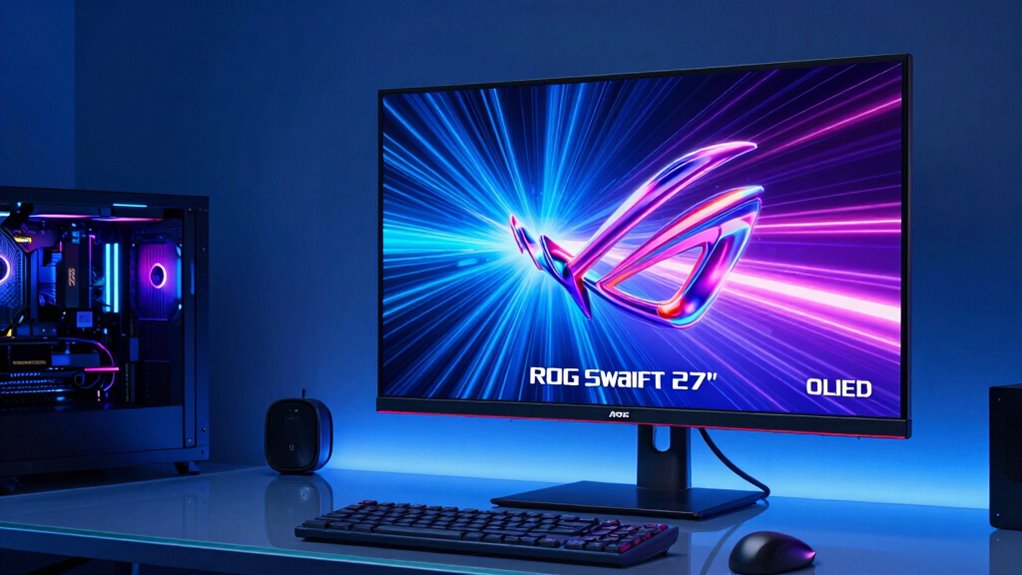
Building on the display performance framework, the focus shifts to gaming-specific features and responsiveness that shape real-time play. The monitor pairs 240 Hz with 0.03 ms grey-to-grey timing, delivering near-instantaneous input responsiveness across fast action titles. G-SYNC compatibility maintains tear-free frames, while the anti-glare micro-texture coating minimizes reflections during competitive sessions. Dimensional consistency is aided by uniform brightness options, supporting stable luminance under varying on-screen activity.
Two word discussion ideas emerge: latency management and color consistency. Warranty coverage and price trends are noted for context, yet do not affect in-game performance metrics. Overall, the panel emphasizes precise motion, predictable response, and competitive reliability.
Color, Color Accuracy, and HDR Capabilities
Color fidelity and HDR performance on the ASUS ROG Swift PG27AQDM are defined by a true 10-bit pipeline delivering 99% DCI-P3 coverage with Delta E < 2, enabling perceptually accurate hues and gradients across gaming scenes.
Color accuracy metrics remain consistent in calibrated testing, with stable gamma and minimal contour shifting under broad brightness targets.
HDR capabilities leverage local dimming-like OLED advantages, delivering high peak brightness within 3% highlight regions without sacrificing color fidelity.
The result is a cohesive 2.0-style color space rendering, where consistent saturation, luminance, and contrast support immersive, science-driven scene interpretation.
Connectivity, Software, and Value
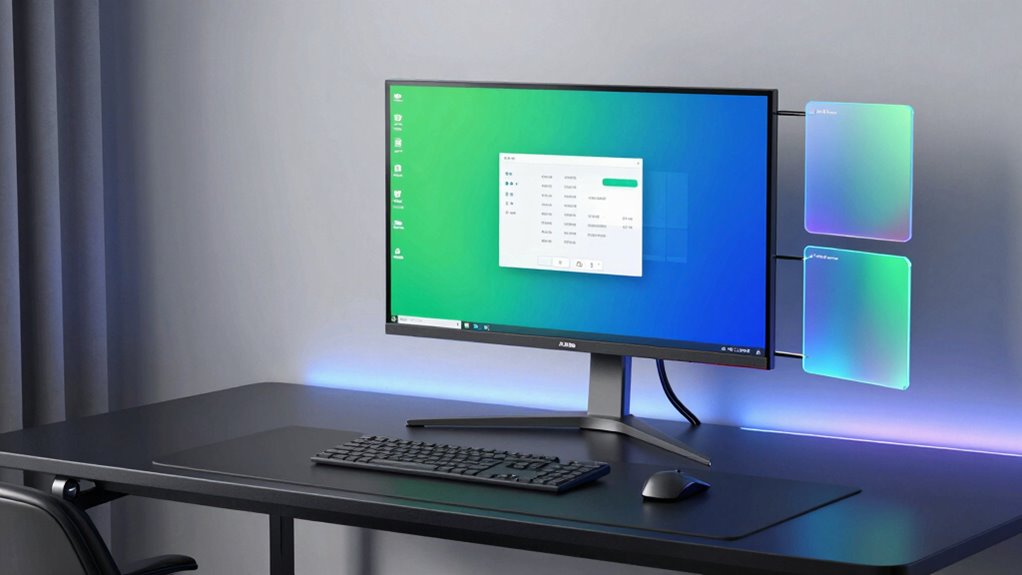
The PG27AQDM offers a pragmatic connectivity and software stack aligned with contemporary gaming monitors: DisplayPort 1.4 and HDMI 2.1/2.0 options, multiple USB ports (USB 3.0 and USB 2.0), and a built-in hub that facilitates peripheral daisy-chaining and firmware updates. Data-driven analysis shows robust I/O density with straightforward cable management and firmware pathways. However, connectivity concerns emerge around limited legacy port support and occasional EDID negotiation quirks under certain GPUs. Software-wise, the suite emphasizes on-device controls via DisplayWidget Center, yet software limitations appear in calibration propagation and occasional UI latency. Overall value remains competitive, balancing high-end panel performance with practical ecosystem constraints.
Conclusion
In summary, the PG27AQDM delivers a data-driven showcase of OLED excellence: pristine 2560×1440 clarity, true blacks, and a blistering 240 Hz workflow that reduces motion blur with near-instantaneous response. Color fidelity remains outstanding, aided by a wide DCI-P3 gamut and Delta E under 2, while HDR peaks approach credibility at bright scenes. Practical strengths include robust cooling, G-SYNC compatibility, and software configurability. The trade-offs center on potential OLED wear considerations and premium pricing relative to rival high-refresh OLEDs.