
The TP-Link AX1800 Archer AX21 emphasizes a compact, hardware-focused design with four high-gain antennas and a sturdy, discrete chassis. It targets reliable Wi‑Fi performance via 802.11ax, delivering up to 1.8 Gbps total bandwidth (2.4 GHz up to 574 Mbps, 5 GHz up to 1200 Mbps) and features like OFDMA and MU‑MIMO for concurrent clients. Security is framed as foundational, with ongoing updates and user-enabled protections. Setup is guided by the Tether app, and further details await those who continue exploring.
Design and Hardware Overview
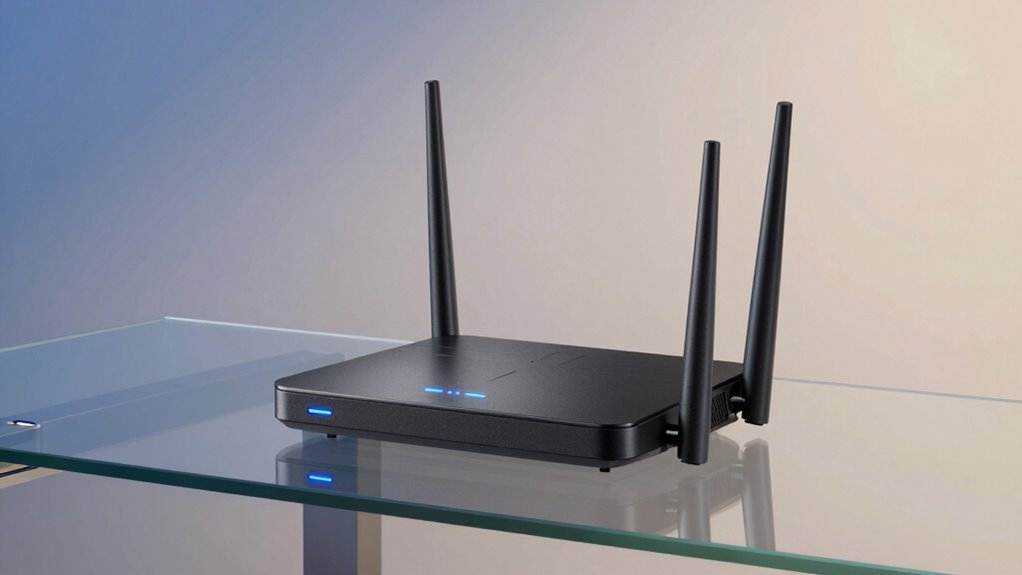
The TP-Link Archer AX21 presents a pragmatic, hardware-focused design that emphasizes practicality over premium aesthetics. The design overview reveals a compact, rectangular chassis with vented panels and four high-gain antennas arranged for broad coverage.
Build quality centers on sturdy plastics and discrete labeling, prioritizing accessible ports and a clean layout over glossy finishes. Internal components align with a mid-range proposition, balancing cost with capability.
Hardware durability is evidenced by simplified cooling paths and a durable front-end module, yet exterior seams show modest flex under pressure.
Wireless Performance and Features
Wireless performance hinges on the AX21’s adherence to 802.11ax specifications, delivering up to 1.8 Gbps total bandwidth with 2.4 GHz at 574 Mbps and 5 GHz up to 1200 Mbps. The device leverages OFDMA and MU-MIMO to sustain concurrent client activity, though real-world speeds are distance- and interference-dependent.
Beamforming concentrates signals toward clients, improving reliability in typical home layouts. Feature comparison reveals solid performance for a midrange AX model, with stable throughput under moderate load.
While not pushing top-tier speeds, the AX21 presents coherent wireless performance within its class, balancing coverage, antennas, and firmware refinement. Overall, strengths lie in efficiency and consistency rather than peak overprovisioning.
Security, Compatibility, and Setup Options

Security considerations, compatibility with a wide range of ISPs, and setup options are presented with an emphasis on proactive protection, broad interoperability, and user-guided configuration.
The Archer AX21 emphasizes security practices as foundational, citing TP-Link’s Secure-by-Design pledge and ongoing firmware updates, but practical hardening relies on timely patches and user-enabled features.
Compatibility considerations are favorable: the device touts compatibility with major providers and standard AC and AX devices, though performance depends on firmware maturity.
Setup options are straightforward via the Tether app, prioritizing guided setup and automatic updates.
Conclusion
The TP-Link AX1800 Archer AX21 demonstrates a pragmatic, no-frills approach that prioritizes reliable coverage over cutting-edge features. Its compact design and dual-band performance suit typical households, with OFDMA improving multi-device efficiency and beamforming enhancing signal reach. Security posture aligns with ongoing firmware updates and the Secure-by-Design pledge, though the omission of the 6 GHz band limits future-proofing. Overall, it trades advanced capabilities for straightforward setup, stable performance, and predictable, everyday reliability.